Frequently Asked Questions
ADC QUESTIONS
No. The intent of “Hub” is to denote the consortium is the place where all stakeholders come together to achieve the ADC vision.
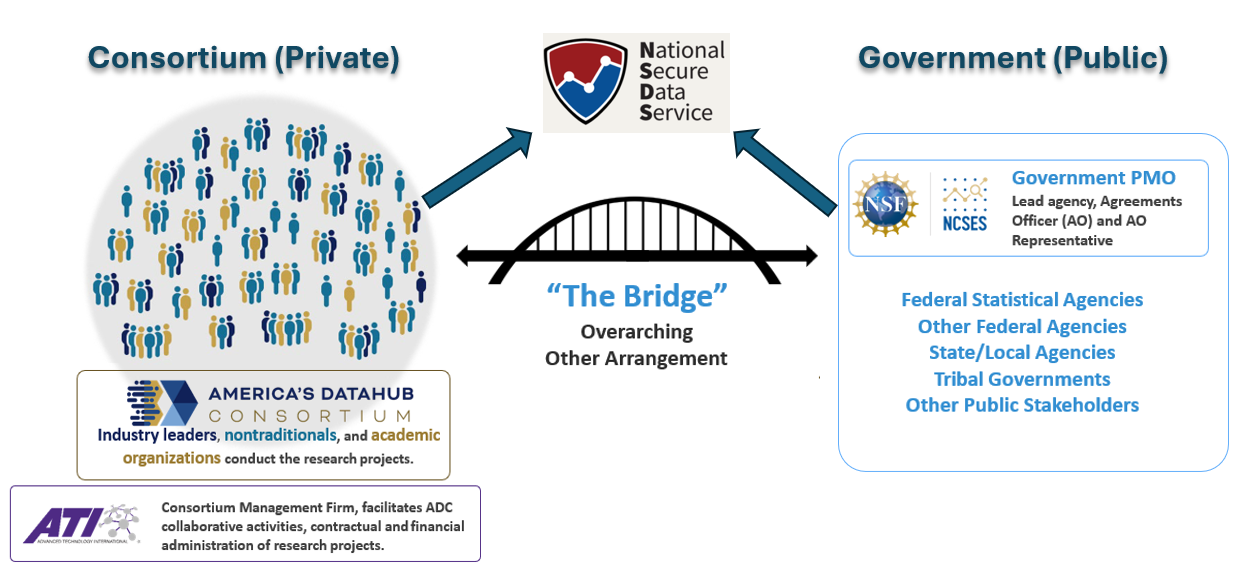
NSF and NCSES established America’s DataHub Consortium in August 2021 to enable evidence-building by streamlining collaboration between researchers, innovators, and subject matter experts. The NSDS-D will create and test the infrastructure and resources that support this shared-service operational model.
ADC utilizes an innovative, flexible, and scalable acquisition process that adapts emerging challenges with secured federal and nonfederal data to inform decision-makers and benefit the American public. It is a public-private partnership that brings together experts from government, industry, and academia to collaboratively research and solve our nation’s toughest challenges.
While the NSDS-D and ADC are different and distinct, their efforts are complementary. ADC is testing potential solutions that demonstrate how data service structures and functions could grow, adapt, and evolve over time to inform the vision for the NSDS.
Representatives that wish to join the ADC mailing list to receive updates regarding future consortium activities should submit a mailing list request form HERE.
The ADC will enable innovative and collaborative evidence building that will help us to better meet the NCSES and NSF missions. It will support and enhance the existing data ecosystem.
Federal statistical agencies and recognized units, other Federal agencies, as well as state and local government agencies can sponsor a project through the ADC.
The DataHub is not designed to be a warehouse, so we do not foresee it storing restricted data—we currently plan to leverage existing data infrastructure as it relates to specially protected data. We are also hoping to leverage existing and developing technologies in terms of privacy protection (i.e. secure multi-party computing is one example).
The ADC will partner with organizations that wish to engage. This could mean sponsoring a project through the ADC directly, partnering with another agency on projects through the ADC, or working with us on evidence building through the ADC.
NSF’s Other Arrangement authority offers regulatory relief from some parts of the Federal Acquisition Regulations (FAR), which allows the consortium to attract non-traditional and non-traditional-to-NSF organizations, meaning those that cannot (or will not) work with the Government due to FAR regulations.
NSF’s Other Arrangement Authority was used for ADC in order to prioritize relational contracting goals. Relational contracting is a method that emphasizes the need to establish a solid working relationship between the government and its contractor and provides flexibility to make adjustments through the life of the contract. The authority allows for flexibility, the prioritization of relationships, and the ability to reach non-traditional and non-traditional-to-NSF organizations.
No, anyone can view and respond to ADC solicitations. If selected for award, you must join ADC.
No, ADC members conduct the project work. The CMF supports the administrative and contracting functions for ADC projects.
NSDS QUESTIONS
No. The intent of the NSDS is to be a shared service where Federal Data can be easily accessed by all, not to hold any data.
NSF and NCSES established America’s DataHub Consortium in August 2021 to enable evidence-building by streamlining collaboration between researchers, innovators, and subject matter experts. The NSDS-D will create and test the infrastructure and resources that support this shared-service operational model.
ADC utilizes an innovative, flexible, and scalable acquisition process that adapts emerging challenges with secured federal and nonfederal data to inform decision-makers and benefit the American public. It is a public-private partnership that brings together experts from government, industry, and academia to collaboratively research and solve our nation’s toughest challenges.
While the NSDS-D and ADC are different and distinct, their efforts are complementary. ADC is testing potential solutions that demonstrate how data service structures and functions could grow, adapt, and evolve over time to inform the vision for the NSDS.
On August 9, 2022, President Joe Biden signed the CHIPS and Science Act of 2022 into law. The legislation authorized the National Science Foundation (NSF) to establish a National Secure Data Service Demonstration Project, or NSDS-D, operated directly or via a contract by the National Center for Science and Engineering Statistics (NCSES). Per Section 10375, the NSDS-D must:
- Consult with the OMB and the National Artificial Intelligence Initiative Act of 2020 Interagency Committee.
- Align with recommendations from the Advisory Committee on Data for Evidence Building (ACDEB).
- Engage with Federal, state, local, and tribal government agencies in support of evidence building.
- Use processes, systems, and technologies to protect restricted data, statistical products, privacy, and confidentiality under the Confidential Information Protection and Statistical Efficiency Act (CIPSEA) of 2018.
- Ensure transparency to the American public.
An NSDS would provide a platform of shared services to streamline and innovate data access, data linkage, and privacy-protections to support expanded data use. Collaboration with all levels of government — including state, local, and tribal governments, as well as non-government stakeholders — will be critical in developing this data ecosystem. The ultimate goal of an NSDS is to support decision-making through the use of data, with particular emphasis on decisions about public programs and policy.
To support this vision, investments to enhance innovations for data linking, data protection, and streamlining processes across the federal government will be critical. The five-year demonstration project (NSDS-D) will inform decisions about whether an NSDS is established and the form it will take, determining what shared services are needed and are most effective, as well as what innovations can support an NSDS.
NCSES, in coordination with the National Science Foundation (NSF), the Office of Management and Budget (OMB), and the Interagency Council on Statistical Policy (ICSP), continues to discuss next steps for the demonstration project to ensure we meet the requirements in the law as well as adhere to the strict security and privacy standards as a principal statistical agency. Funded research opportunities in support of NSDS-D have — and will continue — to be solicited through the ADC.
The NSDS is a high-quality, comprehensive, and trustworthy data are a cornerstone to advancing America’s economy, national security, and prosperity. The National Secure Data Service (NSDS) is envisioned as a secure, scalable service to connect people with the data they need at the appropriate security level and the solutions to solve real-world problems. The NSDS Demonstration is a five-year project (2022-2027) to test and refine models for a full, operational NSDS.
The NSDS fulfills key policy actions in America’s AI Action Plan, which called for the NSDS demonstration to create a secure compute environment and an online portal to provide the public and federal agencies with a front door to AI use-cases involving controlled access to restricted federal data.
The NSDS offers solutions that address critical gaps across the national data infrastructure:
- User-friendly navigation: The Federal statistical system, composed of 16 recognized statistical agencies and units and over 100 other statistical programs, is challenging for data users to navigate and find answers they need.
- Scalable, centralized tools and resources: Agencies often develop powerful tools, but these may exist in siloes and lack scalability.
- Streamlined and secure data sharing across agencies: Data sharing is inhibited by inconsistent data standardization and limited interoperability of agencies’ secure systems.
Plans for NSDS 1.0 include five core features:
- Data Concierge Service: Currently, there is no central space for data users to ask open-ended questions about the nation’s data assets. The Data Concierge Service serves as the intelligent front door to the nation’s data assets, tools, and resources. It includes an AI Chatbot, which answers natural language questions with information sourced directly from federal statistical agency websites, and a human subject matter expert network.
- Data Usage Platform: Currently, there is no shared resource for federal agencies to track the usage of their data assets. The Data Usage Platform provides a user-friendly platform showing the usage of federal data assets, including administrative data and statistical data.
- Capacity Building Center: Data literacy and capacity is an in-demand skill, and while numerous high-quality resources exist, they are scattered across multiple agency websites. The Capacity Building Center will provide training in using NSDS services and resources and curated upskilling resources for educators and users aspiring to build their own capacity for using data to inform their decision-making.
- Communities of Practice: Data users working with government statistical data are often siloed, without the ability to ask questions based on shared research topics. The NSDS Communities of Practice will offer a designated, curated space for data users of all skill levels.
- Secure Compute Environment: The Secure Compute Environment (SCE) provides a technology platform that enables researchers, including federal, state, and local agencies as well as tribal organizations, to share, link data, and expand the utility of existing data.
- These services will be accessible via the NSDS website. In addition, the NSDS GitHub page will host code collections and resources for agencies and data users.
- The NSDS will also offer state-of-the art tools and technologies to enhance data sharing and linkage, such as privacy-preserving record linkage tools and secure multi-party computation tools.
NSDS services will be released on a rolling basis. Tentative dates (subject to change) are below:
- In 2026, the Data Concierge Service, Data Usage Platform, and Secure Compute Environment are scheduled to be released.
- In 2027, the Capacity Building Center, Communities of Practice, and a toolkit will be released.
- Some NSDS features are already available, including the Secure Compute Environment Testbed and privacy-preserving recording linkage tools.
Eight federal agencies have led NSDS demonstration projects to date. Fourteen agencies participate in the NSDS interagency working group and executive ICSP subcommittee dedicated to the NSDS.
Visit the NCSES NSDS webpage to learn more about the vision for the NSDS, its authorizing legislation, and how the NSDS protects privacy and confidentiality.
Membership Questions
We are seeking organizations in the below categories, particularly those non-traditional entities that are new to working with NSF.
- Non-profit entities
- Small businesses
- Large businesses
- Academic organizations
No, international companies are not permitted to join ADC.
An entity (construed in its broadest sense to include qualified large and small businesses, universities, non-profits, philanthropic organizations, partnerships, joint ventures, and other entity forms) that is not currently performing and has not performed, for at least the three-year period preceding the solicitation of sources by NSF for the procurement or arrangement, under any NSF procurement contract or NSF instrument of financial assistance.
No. Only NSF procurement contracts or an NSF instrument of financial assistance need to be assessed.
Annual dues have been waived for the period of October 1, 2023 through September 30, 2026.
An application with all necessary documentation can be processed in as little as 1-2 business days.
No, anyone can view and respond to ADC solicitations. If selected for award, you must join ADC.